


Be part of my network of contacts and let me support you!
Life is generous if we are open to its possibilities, if we are resilient in pursuing our dreams, if we face challenges and overcome difficulties, if we are grateful for our achievements and generate a network of support along the way.
This support network is configured in various areas of life – personal, professional, community or social – and can have various functions, including consolation, clarification, confrontation and provision of energy.
It may include friends, close or distant family, co-workers, neighbors, hobby partners, professional advisors, people from the community, among others.
This network can provide us with people who listen to us, recognise us, console us, clarify us, provide us with energy, connect us with others, confront us to be a better person and a better professional, provide us with information and support us in solving difficulties or problems.
We are social beings, who grow and develop through interaction with other people. It is a give and a receive.
This giving and receiving gives us more and more when it is a generous and true process, focused on developing, empowering and realizing dreams.
My purpose as a Coach is to empower with purpose, contributing with enthusiasm and confidence, to develop the potential of each client through new strategies of thought, emotion and action that promote empowerment, forge strong relationships and overcome barriers.
Life, despite the difficulties and constant challenges, has been generous to me and I am grateful for everything it has given me.
I am happy when I share my knowledge and support the development of my professional clients and everyone around me, when I put my purpose into practice.
I also learn a lot from my clients, who inspire me every day to be a better professional, a better person.
“Openness” is a word that inspired me and marked me enormously during the previous year. Openness to new contacts, new interactions and new opportunities.
With these thoughts in mind, and as part of my social responsibility as a Coach, I offer an opportunity tailored to your circumstances, to those who are committed to their personal and professional development and feel that as a professional Coach I can contribute to achieving their dreams.
I invite you to write to me, tell me about your dreams and projects, and why you believe that a coaching process can contribute to your professional and personal development. If you are truly focused on your development and take responsibility for the process, I offer you the opportunity to support you. You define the price based on your objectives.
The International Coach Federation (ICF) defines Coaching as a process of alliance with the client to promote the stimulation of thinking and creativity in order to maximise their personal and professional potential. Coaching is a personalised and dynamic process where the client identifies and develops the tools to transform into the best version of themselves and map out the steps to achieve their own definition of success.
Write to my email fatima.ribeiro.coach@gmail.com and tell me why you think that a coaching process with me can provide you with support.
This programme will last one year, from June 1, 2018 to June 1, 2019 and, depending on the emails received, each quarter I will offer one person the opportunity to participate in a Coaching process, with conditions to be mutually agreed upon and in accordance with the defined objectives.
Success in your development, in creating a network of contacts, in giving and receiving, in being positive and true in your interactions, contributing to the development of everyone around you!
Fatima Ribeiro

Organisations seek to develop leaders who recognise the impact of globalization on business, who demonstrate the adaptability necessary to succeed in new environments, who develop technological skills in their teams, who appreciate and promote diversity, who focus on collaboration and building trust to develop a vision, a common strategy, and who forge alliances.
In this sense, companies also aspire to develop high-performance teams that communicate effectively, generating motivation and influence in the members of the organisation, that promote the development of the collaborators around them, jointly producing performances higher than those that would be obtained as a product of an individual contribution.
The main advantages of the methodology coaching de equipos de Marshall Goldsmith Stakeholder Center Coaching son:
The team as a whole articulates an area of leadership growth and each team member defines their own area of leadership growth that relates, in turn, to the overall focus of the team. In this way, the team and each of the leaders develop simultaneously.
Team members are positioned to provide expert advice and insight to each other as it relates to their business, their people, and the challenges of their team culture.
When team members collaborate as stakeholders in team coaching programmes, they create an open culture for leadership and team culture change.
Coaching is a leadership skill and leaders in organisations must be experts in promoting the development of their teams and the growth of their collaborators. Team coaching is a great programme to instill coaching as a leadership skill in the organisation.
The Coach works with all team members who support each other in this team coaching process, providing the coaching programme with more efficiency in time and costs for the organisation.
In addition to the above, the Marshall Goldsmith Stakeholder Center Coaching methodology:
I am at your disposal so you can learn more about the process of team coaching de Marshall Goldsmith Stakeholder Centered Coaching.
Write to my email fatima.ribeiro.coach@gmail.com or contact me through my website https://fatimaribeiro.coach/en/
Fatima Ribeiro
More information about Marshall Goldsmith Stakeholder Centered Coaching, visit the website: http://sccoaching.com/coaching-for-executives/

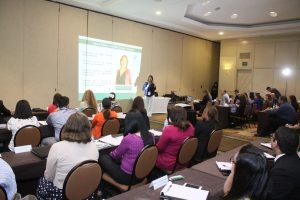
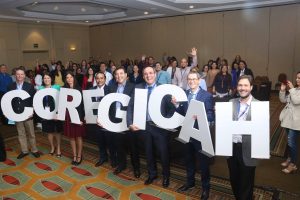
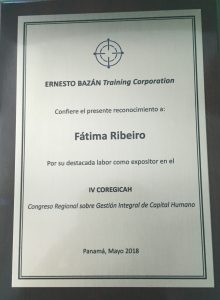
Conference: How to promote the development of leaders. Sponsored by IV COREGICAH – Regional Congress on Comprehensive Human Capital Management.
Date: May, 2018



According to the ICF Global Coaching Study 2016, carried out by ICF (International Coaching Federation) in collaboration with PWC, in 137 countries worldwide, the findings suggest that coaching can influence social change.
Worldwide, 51% of professional coaches surveyed and 49% of managers/directors, with coaching skills, consider that coaching is capable of greatly influencing social change. 33% of professional coaches and 27% of managers/directors, with coaching skills, consider that coaching is capable of moderately influencing social change.
The extent to which professional coaches consider coaching to be able to influence social change varies considerably from region to region.
In Latin America and the Caribbean, two out of every three coaches surveyed (68%) consider that coaching is capable of greatly influencing social change.
According to the ICF Global Consumer Awareness Study 2017, a study carried out by ICG and PWC in 30 countries, the main two benefits recognised in ICF studies on satisfaction with Coaching are improved communication skills (42%), followed by greater self-esteem / self-confidence (40%).
These are skills that create bridges in families, in organisations, in communities, that support a more balanced social and professional integration and that contribute to sustainable social and economic development.
Coaching as a development tool can be applied at different stages of life.
In young people, in professional adults, and in older adults, it contributes to creating greater awareness of one’s own value, to broaden perspectives for personal and professional development, to give a purpose to life and to build a legacy.
It is a tool that supports facing the challenges of each stage of life and conceiving opportunities in an increasingly volatile, uncertain, complex, ambiguous and hyper-connected world (VUCAH).
The improvement of communication skills, the improvement of self-esteem and self-confidence help to reduce isolation in current societies, contributing to a higher level of social integration.
At the organisational level, using coaching as a development tool also brings positive contributions and coaching can contribute to issues such as gender equality, diversity and inclusion.
In the 2017 ICF Global Consumer Awareness Study, the most commonly cited reason for seeking coaching was optimizing individual team work performance (43%), and the third most commonly cited benefit was increased productivity (39%).
Coaching as a tool for social development is thus transversal in society, applying to individuals, communities and nonprofit or profit organisations, collaborating on issues connected to corporate social responsibility and sustainable development objectives.
Fatima Ribeiro